One Year After the Gaza Ceasefire, People Are Still Dying Among the Ruins
13.10.2026
Reading time
less then minute
One year after the ceasefire in the Gaza Strip came into effect, the humanitarian crisis continues. Since 10 October 2025, at least 1,431 Palestinians have been killed. More than 80% of buildings have been damaged, essential medicines remain scarce, and reconstruction has yet to begin. “People are living and dying among the ruins. We cannot allow this to continue,” says Małgorzata Olasińska-Chart of the Polish Medical Mission (PMM).
I’m donating to…


The ceasefire that came into effect on 10 October 2025 has brought neither safety nor the assistance urgently needed by the people of the Gaza Strip. Despite the agreement, shelling and bombardments continue. According to the Gaza Strip Ministry of Health, at least 1,431 Palestinians have been killed over the past 12 months.
The destruction of infrastructure has further exacerbated the situation. More than 80% of buildings have been damaged, and reconstruction has yet to begin. At the same time, more than half of medical facilities are not operational, while those that continue to provide care face shortages of medicines and medical supplies.
“Every day, people are living and dying among the ruins. We cannot allow them to be left without assistance. The problem is not limited to bombardments and shelling. Our medical teams tell us that medicines for cardiovascular diseases and diabetes are virtually unavailable. The lack of these medicines puts patients’ lives at risk,” says Małgorzata Olasińska-Chart of the Polish Medical Mission.
Access to basic treatment is also severely limited. When doctors need to prescribe antibiotics, they can often treat only the most critically ill patients. There are not enough medicines for everyone who needs them, and the available antibiotic is not always the most appropriate one for a patient’s condition.
More than two million people confined to a small area
The humanitarian crisis extends far beyond the lack of access to healthcare. Most residents of the Gaza Strip have been forced to flee their homes. Nearly 65% of the territory lies beyond the so-called Yellow Line, in an area under Israeli control. As a result, more than two million people are crowded into an area roughly comparable in size to the Polish city of Bielsko-Biała.
Around one million people live in tents that offer inadequate protection against both extreme temperatures and flooding during rainfall. These conditions further increase the risk of health problems, particularly among children, older people and those living with chronic illnesses.
“Our medical teams tell us that they are still treating patients suffering from malnutrition. We must remember that the local economy has completely collapsed. People cannot afford to buy food and rely primarily on community kitchens run by local and international organisations,” adds Ewa Piekarska-Dymus of the Polish Medical Mission.
Destroyed farmland and a lack of food security
Residents of the Gaza Strip are also unable to produce enough food for themselves. According to estimates by the United Nations Food and Agriculture Organization (FAO) and the United Nations Satellite Centre (UNOSAT), 97% of agricultural land in the enclave has been destroyed or remains inaccessible to Palestinians.
Combined with the collapse of the local economy and limited access to essential goods, this means that community kitchens remain one of the most important sources of food for many families. Prolonged inadequate nutrition further weakens the body and makes medical treatment more difficult.
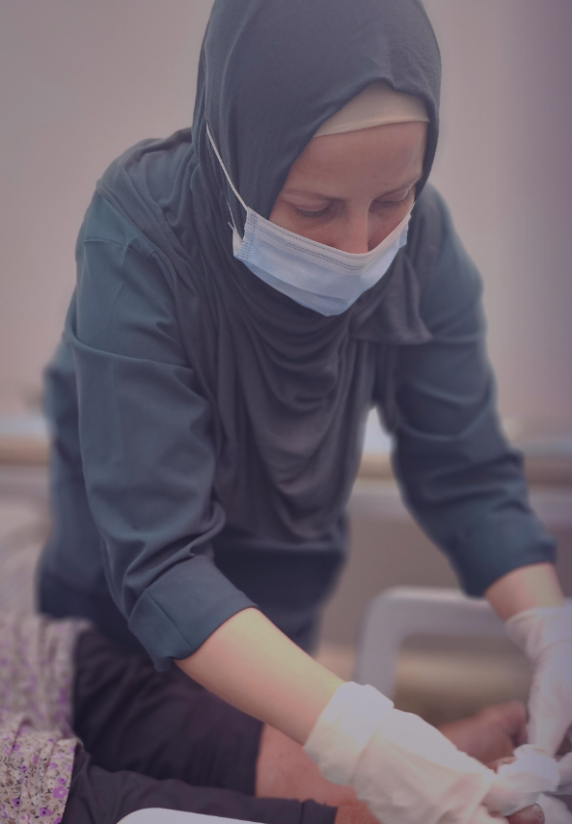
Polish Medical Mission supports wound care in the Gaza Strip
The Polish Medical Mission continues its work to support civilians in the Gaza Strip. In cooperation with its local partner, the organisation GLIA, PMM co-funds a wound care clinic that opened on 1 March at Nasser Hospital in Khan Younis.
Nasser Hospital remains one of the most important medical facilities providing care in the Gaza Strip. With healthcare infrastructure devastated and medical supplies in short supply, supporting medical facilities is essential to ensuring treatment for injured and sick people.
The anniversary of the ceasefire is a reminder that a reduction in hostilities alone is not enough to end the humanitarian crisis. The people of the Gaza Strip still need safety, access to food and medicines, and genuine opportunities to rebuild their homes and their lives.