Nearly 50 Patients in 48 Hours: Large-Scale Emergency Medical Response Exercises
4.11.2026
Reading time
less then minute
A self-built medical base, dozens of simulated cases, evacuations, mass casualty incidents and cooperation with local services. From 23 to 25 October, the Polish Medical Mission’s emergency response team (PMM EMT) took part in large-scale exercises designed to test its readiness to operate in the aftermath of a humanitarian disaster.
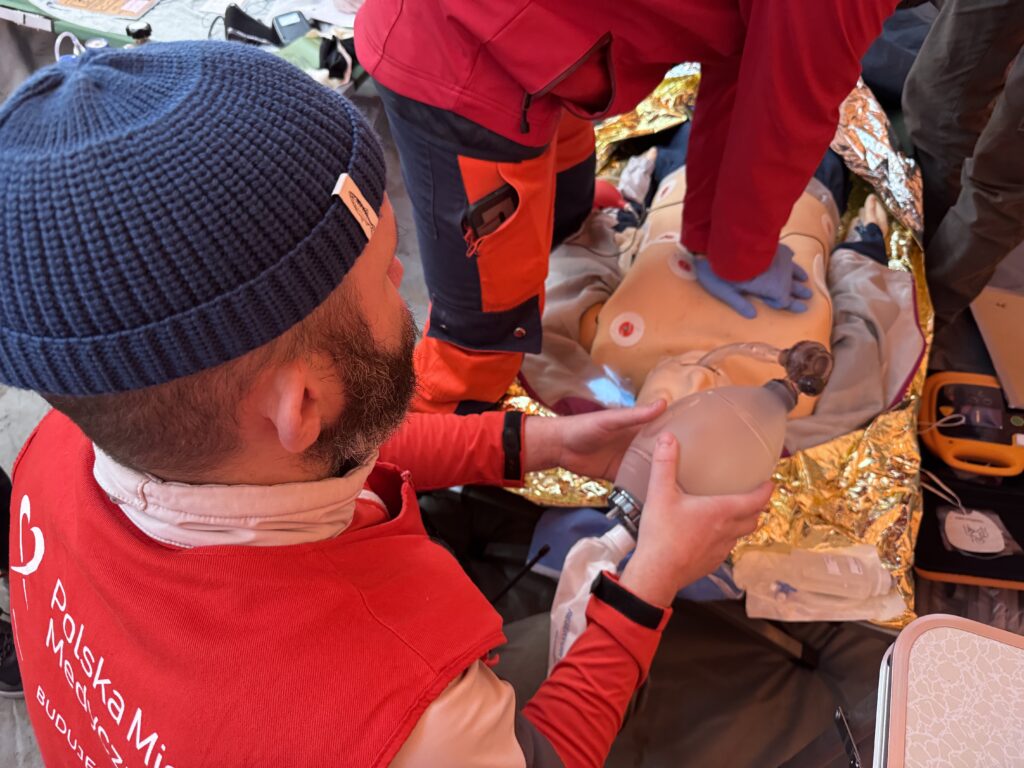
For several dozen hours, the team operated as if it were actually deployed to a disaster-stricken country. Over the course of 48 hours, it provided assistance to nearly 50 simulated patients. Scenarios covered a wide range of medical emergencies, from injuries and serious illnesses to mass casualty incidents, evacuations and threats to personnel safety.
The exercises marked the culmination of more than four months of organisational preparations. They were the first PMM EMT simulation conducted on such a large scale and involving such a broad range of external partners.
Ałdaria: A Fictional Country, Real-World Challenges
The exercises took place in the fictional Mountainous Republic of Ałdaria, a country struck by a disaster caused by heavy rainfall, flash floods and landslides. Damaged roads, limited transport availability, disrupted supply chains and an overwhelmed healthcare system made it difficult to provide assistance to those affected.
The scenario required the team to operate with limited resources, incomplete information and constantly changing field conditions. In addition to assessing patients’ conditions, the team had to take into account transport safety and the availability of more specialised medical care.
These conditions made it possible to test not only the medical team’s clinical skills but also its ability to plan operations, make decisions under pressure and cooperate with other organisations.
A Mobile Medical Unit Ready for Deployment
One of the key elements of the exercises was the independent establishment of a medical base, from setting up the camp to preparing all the facilities necessary to carry out operations. The team organised its own logistics, pharmacy, sanitation facilities and operations coordination centre, while team members slept in tents.
One particularly challenging aspect was that the first mass casualty incident occurred while the base was still being set up, before full operational readiness had been achieved. The team therefore had to carry out organisational preparations while simultaneously receiving patients.
Operations were conducted in accordance with the World Health Organization’s WHO EMT Type 1 Fixed standards. This model refers to a mobile medical facility primarily designed to provide outpatient care, with the capacity to stabilise patients and arrange onward transportation, depending on the team’s needs and capabilities.
From Medical Emergencies to Mass Casualty Incidents
Over the course of 48 hours, the team faced an almost complete cross-section of situations that may arise during a disaster. Simulated cases included cardiogenic shock, sepsis, organophosphate poisoning, acute pancreatitis, severe infections, postpartum haemorrhage, fractures, multiple trauma and cardiac arrest.
The youngest simulated patient was just 14 months old, while the longest individual simulation lasted 14 hours.
Two mass casualty incident scenarios were conducted during the exercises, one at the beginning and another towards the end. The team had to carry out medical triage, establish treatment priorities and make decisions about further patient management with limited resources.
The exercises also included extracting a casualty from a wrecked car following an accident in a landslide-affected area, conducting evacuations and providing medical assistance in situations involving security threats. One scenario involved a simulated attack on the team, while another required providing assistance to a patient following a suicide attempt.
Taking Medical Assistance Beyond the Base
The exercises were not limited to activities within the medical camp. The team also carried out field missions in cooperation with local institutions and organisations involved in the exercise.
These included activities related to evacuating residents of the Leśna Polana Senior Care Home, organising preventive health screening points for the local community, and sourcing the medicines and resources needed to carry out operations. The exercises also included visits from representatives of local authorities and journalists.
Communication with external organisations and coordinating activities in a rapidly changing situation were also important elements. In addition to medical care, the team practised cooperation, information management and the logistics essential to carrying out a humanitarian operation.
Preparing for Emergencies in Poland
The exercises were important not only in the context of international humanitarian operations. The Polish Medical Mission’s emergency response team is a designated civil protection entity under the Governor of the Małopolska Region. The exercises also formed part of its preparations to operate independently within Poland in the event of a disaster or other emergency.
The extended simulations provided an opportunity to test procedures, develop the team’s skills and refine its Standard Operating Procedures (SOPs). Another important experience was the need to conduct medical, logistical and coordination activities simultaneously, without knowing in advance how many patients there would be or what types of incidents might occur.
“During a disaster, medical knowledge alone is not enough. Efficient organisation, the ability to make decisions under uncertainty and cooperation with other emergency services are equally important. Exercises like these allow us to put these elements to the test and better prepare ourselves to provide assistance wherever it is needed most,” says Ewa Piekarska-Dymus, President of the Polish Medical Mission.
A Joint Effort Involving Multiple Organisations
The exercises were made possible thanks to the involvement of organisations, emergency services, institutions and partners who supported the operation at various stages.
The Polish Medical Mission would like to thank everyone involved for their cooperation, the resources made available, organisational support and contribution to strengthening preparedness for emergency response.
Partners and organisations involved in the exercises:
- Stowarzyszenie NOVIGO
- VASCO-electronics
- Sky Access Team S.C.
- BLS Academy
- Maltańska Służba Medyczna Oddział Krzeszowice
- OSP Stare Bukowno
- Stowarzyszenie Taktyczno-Strzeleckie S.T.S.
- Grupa Ratownictwa PCK Kraków
- Dom Seniora „Leśna Polana”
- Bera Phantoms
- Jednostka Strzelecka nr 2092 w Tarnowie
- Humanosh Emergency Medical Team
- Medyk Rescue Team
- Ranger Survival Club
- Fundacja MSAR POLAND
- Komenda Miejska Państwowej Straży Pożarnej w Rybniku
- Sklep z odzieżą używaną Maria Ochnio
- Leśnictwo Bukowno
- Nadleśnictwo Olkusz
- Parafia pw. św. Andrzeja Boboli w Bukownie
- Apteka Zdrowie